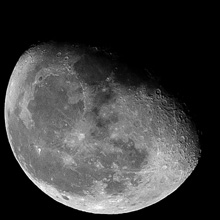
Tuesday, May 21, 2013 Venus is 6.7 degrees to the lower right of Jupiter. Mercury is 2.5 degrees to the lower right of Venus. Look to the WNW 30 minutes after sunset. Use binoculars.
Nasa Image of the Day
The Twin Rectangular Jet model, installed on the Nozzle Acoustic Test Rig in the Aeroacoustic Propulsion Laboratory at NASA's Glenn Research Center being tested.

The Twin Rectangular Jet model, installed on the Nozzle Acoustic Test Rig in the Aeroacoustic Propulsion Laboratory at NASA's Glenn Research Center being tested.

The Twin Rectangular Jet model, installed on the Nozzle Acoustic Test Rig in the Aeroacoustic Propulsion Laboratory at NASA's Glenn Research Center, is being tested to determine the acoustic impact of engine configurations on low sonic boom aircraft for the High Speed Project of the Fundamental Aeronautics Program. The High Speed Project is a multi-center effort to develop and test the technologies of a new generation of aircraft that can fly at supersonic speeds. Glenn's research involves predicting the airport noise of these novel aircraft by examining innovative airframes and propulsion integration that are different from the conventional tube-and-wing aircraft observed at commercial airports. Inside the aeroacoustic dome, this generic, low-fidelity aircraft engine exhaust model features twin rectangular nozzles. Researchers are investigating the impact of having the propulsive exhaust come from the slot nozzles atop the aircraft. Testing the proposed components of these high- speed aircraft will help manufacturers meet the noise standards required around the nation's airports. Image Credit: NASA/Bridget R. Caswell

Book Store
Wonders of the Solar System Wonders of the Solar System

Astronomy.co.uk has teamed up with Amazon.co.uk to bring you the finest selection of astronomy related books at the best prices.

Browse through our bookstore and check out our fine selection of books from star charts and astrophotography to mathematical astronomy. We are sure you will find the book that best suits your needs.

Sky View Cafe
Sky View Cafe

Sky View Café is a Java applet that lets you use your web browser to see many types of astronomical information, in both graphical and numerical form. You can see which stars and planets will be out tonight in the sky above your home town, see how the next solar or lunar eclipse will look from London, or find out when the Moon rose over Sydney on your birthday ten years ago. Sky View Café includes star charts, a 3-D orrery, displays of the moons of Jupiter and Saturn, an astronomical event calendar, an ephemeris generator, and many other features. Enter Sky View Café now!

Astronomy News
Hubble Finds Dead Stars 'Polluted' with Planet Debris
Thu, 09 May 2013 10:00:00 -0400Hubble Image

Deep inside the Hyades star cluster, a pair of burned-out stars are yielding clues to the presence of rocky planets that may have whirled around them. Asteroid debris is 'raining' into the hot atmospheres of these white dwarfs. Asteroids should consist of the same material that form terrestrial planets, and seeing evidence of asteroids points to the possibility of Earth-sized planets in the same system.


STScI Appoints New Mission Head for the James Webb Space Telescope
Tue, 07 May 2013 11:00:00 -0400Hubble Image

The Space Telescope Science Institute has appointed Dr. Massimo Stiavelli as the James Webb Space Telescope (JWST) Mission Head. Stiavelli will be responsible for the development and operations of the JWST Science and Operations Center at STScI. He has been acting JWST Mission Head since January 2012. The largest space observatory ever developed, JWST is scheduled for launch in 2018. Stiavelli succeeds Dr. Kathy Flanagan, who was appointed the Institute's Deputy Director in October 2012. Stiavelli has worked at the Institute for over 17 years. His many positions at the Institute include instrument scientist for three Hubble cameras. Stiavelli has been working on the JWST project since 1996.


Herschel finds hot gas on the menu for Milky Way’s black hole - Read more >
Tue, 07 May 2013 12:00:00 +0200


ESA’s Herschel space observatory has made detailed observations of surprisingly hot molecular gas that may be orbiting or falling towards the supermassive black hole lurking at the centre of our Milky Way galaxy.


Landslides and lava flows at Olympus Mons on Mars - Read more >
Thu, 02 May 2013 11:00:00 +0200


Giant landslides, lava flows and tectonic forces are behind this dynamic scene captured recently by ESA’s Mars Express of a region scarred by the Solar System’s largest volcano, Olympus Mons.


Herschel closes its eyes on the Universe - Read more >
Mon, 29 Apr 2013 17:30:00 +0200


ESA’s Herschel space observatory has exhausted its supply of liquid helium coolant, ending more than three years of pioneering observations of the cool Universe.


Hubble Captures Comet ISON
Tue, 23 Apr 2013 13:00:00 -0400Hubble Image

Comet ISON is potentially the "comet of the century" because around the time the comet makes its closest approach to the Sun, on November 28, it may briefly become brighter than the full Moon. Right now the comet is far below naked-eye visibility, and so Hubble was used to snap the view of the approaching comet, which is presently hurtling toward the Sun at approximately 47,000 miles per hour. When the Hubble picture was taken on April 10, the comet was slightly closer than Jupiter's orbit at a distance of 386 million miles from the Sun. Even at that great distance the Sun is warming the comet enough to trigger outgassing from its frozen gases locked up in the solid nucleus. Hubble photographed a jet blasting dust particles off the sunward-facing side of the comet's nucleus. Preliminary measurements from the Hubble images suggest that the nucleus of ISON is no larger than three or four miles across. The comet was discovered in September 2012 by the Russian-led International Scientific Optical Network (ISON) using a 16-inch telescope.


Herschel links Jupiter’s water to comet impact - Read more >
Tue, 23 Apr 2013 10:00:00 +0200


ESA’s Herschel space observatory has solved a long-standing mystery as to the origin of water in the upper atmosphere of Jupiter, finding conclusive evidence that it was delivered by the dramatic impact of comet Shoemaker-Levy 9 in July 1994.


Herschel and Hubble see the Horsehead in new light - Read more >
Fri, 19 Apr 2013 15:00:00 +0200


New views of the Horsehead Nebula and its turbulent environment have been unveiled by ESA’s Herschel space observatory and the NASA/ESA Hubble space telescope.


Hubble Sees a Horsehead of a Different Color
Fri, 19 Apr 2013 08:50:00 -0400Hubble Image

Unlike other celestial objects there is no question how the Horsehead Nebula got its name. This iconic silhouette of a horse's head and neck pokes up mysteriously from what look like whitecaps of interstellar foam. The nebula has graced astronomy books ever since its discovery over a century ago. But Hubble's infrared vision shows the horse in a new light. The nebula, shadowy in optical light, appears transparent and ethereal when seen at infrared wavelengths. This pillar of tenuous hydrogen gas laced with dust is resisting being eroded away by the radiation from a nearby star. The nebula is a small part of a vast star-forming complex in the constellation Orion. The Horsehead will disintegrate in about 5 million years.


Star factory in the early Universe challenges galaxy evolution theory - Read more >
Wed, 17 Apr 2013 19:00:00 +0200


ESA’s Herschel space observatory has discovered an extremely distant galaxy making stars more than 2000 times faster than our own Milky Way. Seen at a time when the Universe was less than a billion years old, its mere existence challenges our theories of galaxy evolution.


Explosive crater twins on Mars - Read more >
Thu, 11 Apr 2013 11:00:00 +0200


Dramatic underground explosions, perhaps involving ice, are responsible for the pits inside these two large martian impact craters, imaged by ESA’s Mars Express on 4 January.


NASA and STScI Select 17 Hubble Fellows for 2013
Tue, 09 Apr 2013 14:00:00 -0400Hubble Image

NASA and the Space Telescope Science Institute (STScI) have announced the selection of 17 new Hubble Fellows. The Hubble Fellowship Program now includes all research relevant to present and future missions in NASA's Cosmic Origins theme. These missions currently include the Herschel Space Observatory, the Hubble Space Telescope (HST), the James Webb Space Telescope (JWST), the Stratospheric Observatory for Infrared Astronomy (SOFIA), and the Spitzer Space Telescope. STScI in Baltimore, Md., administers the Hubble Fellowship Program for NASA.


Retired star found with planets and debris disc - Read more >
Tue, 09 Apr 2013 11:00:00 +0200


ESA’s Herschel space observatory has provided the first images of a dust belt – produced by colliding comets or asteroids – orbiting a subgiant star known to host a planetary system.


Hubble Breaks Record in Search for Farthest Supernova
Thu, 04 Apr 2013 10:00:00 -0400Hubble Image

A long time ago, in a galaxy far, far away, a star detonated with enough energy to briefly shine with an intrinsic brightness of one billion of our suns. The beacon of radiation arrived at Earth 10 billion years later and was captured in a Hubble Space Telescope deep survey of the universe. It is the farthest, and earliest, supernova of its type detected to date. More than simply an example of the ancient fireworks in the young and effervescent universe, the supernova belongs to a special class of stellar detonations that are so reliably bright, they can be used as intergalactic milepost markers.


Taken Under the "Wing" of the Small Magellanic Cloud
Thu, 04 Apr 2013 09:00:00 -0400Hubble Image

NASA's Chandra X-ray telescope has made the first detection of X-ray emission from young solar-type stars that lie outside our Milky Way galaxy. They live in a region known as the "Wing" of the Small Magellanic Cloud, a satellite galaxy of our Milky Way. X-rays from young stars trace how active their magnetic fields are. Magnetic activity provides clues to a star's rotation rate and the rising and falling of hot gas in the star's interior. Astronomers suggest that if the X-ray properties of young stars are similar in different environments around our galaxy, then other related properties, such as the formation of planets, are also likely to be similar.


Black hole wakes up and has a light snack - Read more >
Tue, 02 Apr 2013 11:00:00 +0200


Astronomers have watched as a black hole woke up from a decades-long slumber to feed on a low-mass object – either a brown dwarf or a giant planet – that strayed too close. A similar feeding event, albeit on a gas cloud, will soon happen at the black hole at the centre of our own Milky Way Galaxy.


Hunting high-mass stars with Herschel - Read more >
Wed, 27 Mar 2013 11:00:00 +0100


In this new view of a vast star-forming cloud called W3, ESA’s Herschel space observatory tells the story of how massive stars are born.


Planck reveals an almost perfect Universe - Read more >
Thu, 21 Mar 2013 11:00:00 +0100


Acquired by ESA’s Planck space telescope, the most detailed map ever created of the cosmic microwave background – the relic radiation from the Big Bang – was released today revealing the existence of features that challenge the foundations of our current understanding of the Universe.


Black hole-star pair orbiting at dizzying speed - Read more >
Tue, 19 Mar 2013 14:00:00 +0100


ESA’s XMM-Newton space telescope has helped to identify a star and a black hole that orbit each other at the dizzying rate of once every 2.4 hours, smashing the previous record by nearly an hour.


ExoMars: ESA and Roscosmos set for Mars missions - Read more >
Thu, 14 Mar 2013 12:00:00 +0100


ESA and the Russian federal space agency, Roscosmos, have signed a formal agreement to work in partnership on the ExoMars programme towards the launch of two missions in 2016 and 2018.


NASA Helps Make Guinness World Record for Largest Astronomy Lesson at SXSW
Wed, 13 Mar 2013 13:00:00 -0400Hubble Image

Looking up through hundreds of colored filters and spectral glasses, 526 people shattered the record for the Largest Astronomy Lesson. Under the Texas night sky, students were instructed on the lawn of the Long Center for the Performing Arts at the South by Southwest (SXSW) festival in Austin on Sunday, March 10, 2013.


Call for Media: First cosmology results from ESA’s Planck mission - Read more >
Wed, 13 Mar 2013 10:00:00 +0100


Media representatives are invited to a briefing on the first cosmology data release from ESA’s Planck mission. The new results include Planck’s first all-sky map of the cosmic microwave background.


Hubble Finds Birth Certificate of Oldest Known Star
Thu, 07 Mar 2013 14:00:00 -0500Hubble Image

You can't be older than your parents. But there is a nearby star that at first glance looks like it is older than the universe! Hubble Space Telescope astronomers are coming to grips with this paradox by improving the precision of the observations used to estimate the age of this "Methuselah star."


Gravitational Lens Creates Cartoon of Space Invader
Tue, 05 Mar 2013 09:00:00 -0500Hubble Image

The universe is eerie enough without giving us an apparition of a 1980s video game alien attacker. This oddball-looking object is really a mirage created by the gravitational field of a foreground cluster of galaxies warping space and distorting the background images of more distant galaxies.


Herschel to finish observing soon - Read more >
Tue, 05 Mar 2013 11:00:00 +0100


ESA’s Herschel space observatory is expected to exhaust its supply of liquid helium coolant in the coming weeks after spending more than three exciting years studying the cool Universe. 


Cassini Scientist for a Day 2012 Competition - Results - Read more >
Mon, 04 Mar 2013 11:15:00 +0100


Students from across Europe have been selected as winners of the Cassini Scientist for a Day 2012 competition. Coordinated by ESA, national competitions were held in several European countries, including Poland, Spain and Greece, with more than 1000 entries. An equivalent competition was run by NASA for schools in the US.


Speedy black hole holds galaxy’s history - Read more >
Wed, 27 Feb 2013 19:00:00 +0100


A rapidly rotating supermassive black hole has been found in the heart of a spiral galaxy by ESA’s XMM-Newton and NASA’s NuSTAR space observatories, opening a new window into how galaxies grow.


ESA chooses instruments for its Jupiter icy moons explorer - Read more >
Thu, 21 Feb 2013 13:00:00 +0100


The JUpiter ICy moons Explorer mission, JUICE, will carry a total of 11 scientific experiments to study the gas giant planet and its large ocean-bearing moons, ESA announced today.


The Sky Tonight This Month's Sky Map
This Month's Sky Map

Take a look at this month's Sky Map to help you explore the wonders of the night sky!

Ideal for all sky watchers including beginners to astronomy.

The Sky Map will help you identify planets, bright stars, constellations and nebulae!
Printable version available too!


Buy A Star Gift - Name a star for any occasion, view it live on Google Sky
Universal Star Registry Certificate

Astronomy.co.uk Star Naming Service
Name a star for yourself or for that special person as the perfect gift that will sparkle for a lifetime! Ideal for any occassion, birthdays, christenings, anniversaries and memorials. Reserve a place in the heavens for your loved ones


Follow AstronomyUK on Twitter